
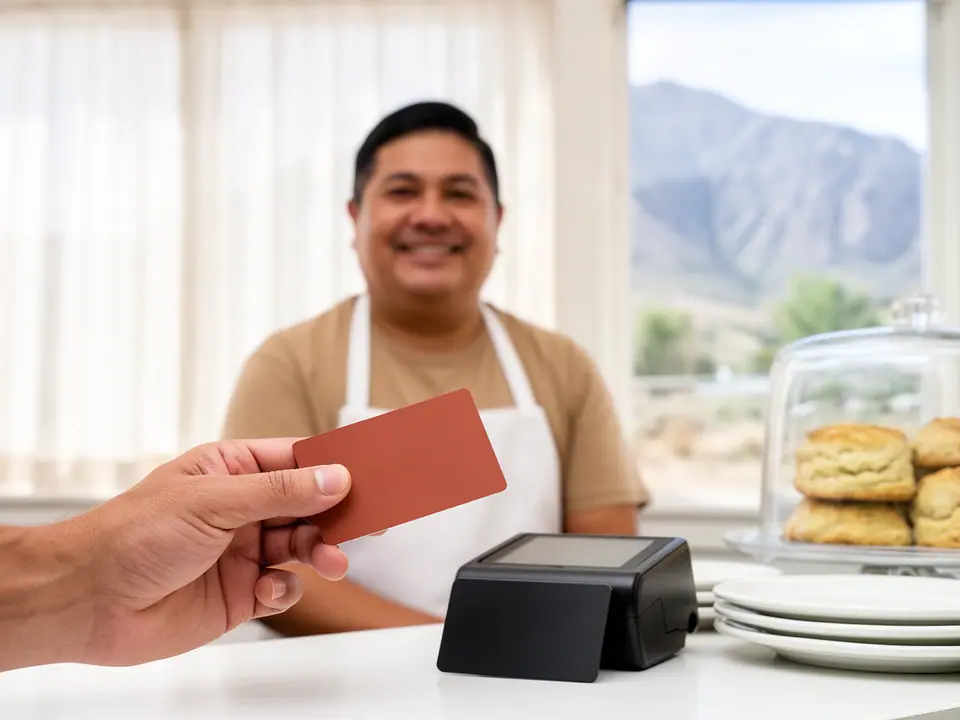
Clayland Commercial Capital passes requests to independent providers, who set any advance, factor and holdback.
The factor sets the total to be collected, and the holdback sets how much of each day's card sales goes toward it. Strong sales days finish the advance sooner and lighter ones stretch it out, but the total stays the same.
At a glance
- What it is
A lump sum now for a share of future card sales
- What sets the cost
A factor applied once to the advance amount
- How it is collected
A fixed holdback from each day's card sales
How a merchant cash advance is collected from card sales after a Box Elder County, UT auto repair shop's equipment breakdown
When two pieces of an auto repair shop's own equipment fail in the same week, the repair bills come due at once while card payments from customers keep arriving daily. With an advance, the provider pays the shop a lump sum and then takes an agreed share of each day's card settlements until the full agreed amount has been collected.
Collection can run through the card processor: the holdback is split off before the rest of the batch reaches the shop's account. A provider may instead debit a set daily amount from the bank account and true it up to actual card sales; the offer says which method applies.
County Business Patterns listed 38 auto repair and maintenance employers in Box Elder County, UT for 2023 (NAICS 8111). ZIP Code Business Patterns shows 16 auto repair employers with ZIP 84302 addresses.
Working out what a factor costs, using a Brigham City, UT furniture store's daily card sales
A factor is a multiplier applied once to the advance. The advance times the factor gives the amount the provider collects, and that amount less the advance is the dollar cost. How long collection takes then depends on the holdback and on card sales.
Illustration only, invented figures: a furniture store takes a $27,465 advance at a factor of 1.37, so the invented total to be collected is $37,627.05 and the invented cost is $10,162.05. In this invented case the holdback is 7% of each day's card sales and those sales average $2,745, so about $192.15 goes to the provider each business day, and the invented total is collected in about 196 business days.
| Item | Invented figure | How it is worked out |
|---|---|---|
| Average daily card sales | $2,745 | Invented average for the store |
| Holdback per business day | $192.15 | 7% of $2,745 in daily card sales |
| Business days to finish | about 196 | Total to be collected over the daily holdback, rounded up to the next whole day |
| Total to be collected | $37,627.05 | The $27,465 advance times the 1.37 factor |
| Cost of the advance | $10,162.05 | Total to be collected minus the $27,465 advance |
Because the cost is fixed in dollars, a shorter collection period means a higher cost for each day the money is out. County Business Patterns counted 5 furniture and home furnishings stores with paid employees in Box Elder County, UT for 2023 (NAICS 442). Nonemployer Statistics listed 12 furniture and home furnishings retailers without paid staff in the county in 2024.
An advance beside a credit line draw for a Brigham City, UT western wear store's stock order
A western wear store placing a large stock order could take an advance or draw on a credit line, and the two charge for time in opposite ways. A line charges interest on the balance for as long as it is out, so paying it down sooner costs less. An advance carries a fixed dollar cost, so finishing it sooner does not lower the total.
Illustration only, invented figures: on a $12,635 order, an advance at a factor of 1.21 costs $2,653.35, collected at a holdback of 9% from invented daily card sales of $1,145 over about 149 business days. A credit line draw of the same invented amount at an annual rate of 16.41%, paid down in 6 equal monthly payments of $2,207.76, costs about $611.56 in invented interest.
A western wear store falls under clothing and clothing accessories stores, a small group in Box Elder County, UT: 5 employer establishments in 2023, 60.0% of them with fewer than five employees (County Business Patterns, NAICS 448). For how draws and limits work, see the business line of credit page.
From offer to final remittance: the steps of an advance at a Box Elder County, UT burger stand
- The owner calls (435) 220-7289 with the amount and what it pays for.
- Card processing statements from recent months, along with bank statements, are papers a provider may ask to see.
- The provider's offer, if it makes one, spells out the advance, the factor, the holdback and how collection works.
- If the owner signs, the provider sends the advance to the business account.
- Each day's card sales give up the holdback share until the provider has collected the agreed total.
Before signing, the owner can ask whether any fee applies on top of the factor and how the daily amount is checked against actual card sales.
A burger stand belongs to accommodation and food services, which County Business Patterns put at 96 employer establishments in Box Elder County, UT for 2023, 27.1% of them below five employees.
Card-taking businesses an advance can suit, set against Box Elder County, UT Census counts
An advance is sized to card sales, so it fits most naturally where customers pay by card at the counter: restaurants and snack bars, retail stores, salons and repair shops. A business that bills other companies on invoices, such as a machine shop or a contractor, has little card volume for a holdback to draw on and may look at working capital or a credit line instead. ZIP 84302 had 53 employer establishments in Accommodation and Food Services in 2023 (ZIP Code Business Patterns); the Brigham City, UT page sets that row beside five other ZIP 84302 sectors.
County Business Patterns listed 16 beauty salons with paid staff in Box Elder County, UT for 2023 (NAICS 812112). The 2023 ZIP Code Business Patterns file lists 64 retail employer establishments at ZIP 84302.
What a provider buys with an advance, and what that means for a Brigham City, UT retailer's supplier payments
An advance is a discounted purchase: the provider pays less today than the card sales it expects to receive later. That is why the contract speaks of a purchase price, a purchased amount and a specified percentage. For a retailer paying a supplier with the advance, the practical point is that the cost is fixed at signing and the daily amount moves with sales.
It also means an advance carries no annual rate. To set it beside an installment offer, the retailer can divide the dollar cost by the advance and weigh that share against the months the collection is expected to take. The business loans page lists the five loan types for comparison.
By Clayland Commercial Capital · Updated